Monitoring and Managing Microsoft Exchange Server 2003
This authoritative book teaches IT professionals responsible for Exchange messaging systems how to efficiently manage the program's many and complex system capabilities and features.
 TABLE OF CONTENTS
 One of the goals of any Information Technology (IT) operations team is to maximize the availability of business-critical IT services, and one of the keys to maximizing availability is to ensure that the network and the infrastructure are reliable. I have had the opportunity to help many different companies over the years, and all Chief Information Officers and IT managers eventually ask about infrastructure reliability that is, how to reduce unplanned downtime. Unfortunately, sometimes these managers attempt to apply a solution to the problem without fully understanding the problem. For example, they may want to implement clusters or Microsoft Windows Datacenter in the belief that this alone will solve their reliability problems. However, hardware reliability is just one cause for unplanned downtime and it is not really the most significant problem.
Various organizations have done surveys to gather information about the causes of unexpected downtime. For example, Figure 2.1 shows results collected by Ontrack Data International Incorporated (http://www.ontrack.com/ ).
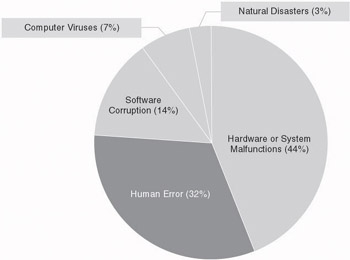
Hardware or system malfunctions accounted for 44% of downtime. These include incidents such as electrical failures, head crashes, and controller failures.
Human error accounted for 32% of downtime. This includes accidental deletion of critical files, inadvertent drive formatting, dropping disk drives, poor network architectures, and sloppy data center procedures.
Software corruption accounted for 14% of downtime. This includes corruption caused by improper use of diagnostic or repair tools, failed backups, and overly complex configurations.
Computer viruses accounted for 7% of downtime.
Natural...