Microsoft Exchange Server for Windows 2000: Planning, Design, and Implementation
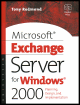
A comprehensive resource for implementors and managers of Exchange Server 2000 networks.
 TABLE OF CONTENTS
 Sometimes Exchange servers need to communicate through a firewall. Perhaps sites are linked together using X.400 connectors over the public Internet, or maybe you want to enable client connectivity from insecure locations. In these and other instances, you'll need to enable different TCP/IP ports on the firewall to let traffic through. Table A.1 details the ports used by the different services associated with Exchange, as well as some of those that you might need to use to perform Windows 2000 management tasks.
| Port number | Used by |
|---|---|
| 25 | SMTP (including client access to send messages) |
| 67 | DHCP client |
| 80 | HTTP |
| 102 | X.400 over TCP/IP (RFC 1006) |
| 110 | POP3 client connections to IIS |
| 119 | NNTP (RFC 977) |
| 135 | RPC end-point mapper (dynamic reallocation for MAPI client access to Information Store); also used by MTA to determine ports |
| 139 | DNS administration |
| 143 | IMAP client connections to IIS |
| 389 | LDAP |
| 443 | Secure HTTP (HTTPS via SSL) |
| 465 | Secure SMTP (via SSL) |
| 636 | Secure LDAP (via SSL) |
| 691 | Link State Table Updates |
| 750 | Kerberos Authentication |
| 751 | Kerberos Authentication |
| 752 | Kerberos Password Server (UDP) |
| 753 | Kerberos User Registration Server (UDP) |
| 754 | Kerberos Slave Propagation |
| 888 | Login and Environment Passing |
| 993 | Secure IMAP (via SSL) |
| 995 | Secure POP3 (via SSL) |
| 1025 | Directory Replication |
| 1080 | Instant Messaging |
| 1109 | POP with Kerberos |
| 1723 | PPTP Control Channel (IP Protocol 47 GRE) |
| 2053 | Kerberos de-multiplexor |
| 2105 | Kerberos encrypted rlogin |
| 3268 | GC replication |
| 3269 | GC access |
| 3389 | Windows 2000 Terminal Services |