Preface
In this book, methods of adaptive signal processing are borrowed from the field of digital signal processing to solve problems in dynamic systems control. Adaptive filters, whose design and behavioral characteristics are well known in the signal processing world, can be used to control plant dynamics and to minimize the effects of plant disturbance. Plant dynamic control and plant disturbance control are treated herein as two separate problems. Optimal least squares methods are developed for these problems, methods that do not interfere with each other. Thus, dynamic control and disturbance canceling can be optimized without one process compromising the other. Better control performance is the result. This is not always the case with existing control techniques. Inverse control of plant dynamics involves feed-forward compensation, driving the plant with a filter whose transfer function is the inverse of that of the plant. Inverse compensation is well known in signal processing and communications. Every MODEM in the world uses adaptive filters for channel equalization. Similar techniques are described here for plant dynamic control. Inverse control is feed-forward control. The same precision of feedback that is obtained with existing control techniques is also obtained with adaptive feed-forward control since feedback is incorporated in the adaptive algorithm for obtaining the parameters of the feed-forward compensator. Inverse control can be used effectively with minimum phase and non-minimum phase plants. It cannot work with unstable plants, however. They must first be stabilized with conventional feedback, of any design that simply achieves stability. Then the plant and stabilizing feedback can be treated as an equivalent stable plant that can be controlled in the usual way with adaptive inverse control. Model reference control can be readily incorporated into adaptive inverse control. Adaptive noise canceling techniques are described that allow optimal reduction of plant disturbance, in the least squares sense. Adaptive noise canceling does not affect inverse control of plant dynamics. Inverse control of plant dynamics does not affect adaptive disturbance canceling. If initial feedback is needed to provide plant stabilization, the design of the stabilizer has no effect on the optimality of the adaptive disturbance canceler. The designs of the adaptive inverse controller and of the adaptive disturbance canceler are quite simple once the control engineer gains a mastery of adaptive signal processing. This book provides an introductory presentation of this subject with enough detail to do system design. The mathematics is simple and indeed the whole concept is simple and easy to implement, especially when compared with the complexity of current control methods. Adaptive inverse control is not only simple, but it affords new control capabilities that can often be superior to those of conventional systems. Many practical examples and applications are shown in the text. Another feature of adaptive inverse control is that the same methods can be applied to adaptive control of nonlinear plants. This is surprising because nonlinear plants do not have transfer functions. But approximate inverses are possible. Experimental results with nonlinear plants have shown great promise. Optimality cannot be proven yet, but excellent results have been obtained. This is a very promising subject for research. The whole area of nonlinear adaptive filtering is a fascinating research field that already shows great results and great promise. This book was originally published under the title Adaptive Inverse Control. We are grateful to IEEE Press and John Wiley, Inc. for bringing it back into print. We are also grateful to colleagues Gene Franklin, Karl Johan Astrom, Jose Cruz, Brian Anderson, Paul Werbos, and Shmuel Merhav for their early comments, suggestions, and feedback. We are grateful to former Stanford students Steve Piche, Michel Bilello, Gregory Plett, and Ming-Chang Liu who confirmed the results with experiments and who assisted with preparation of the drawings and final manuscript. Bernard Widrow Eugene Walach |
 TABLE OF CONTENTS
 Chapter 8 - Plant Disturbance Canceling
Plant Disturbance Canceling
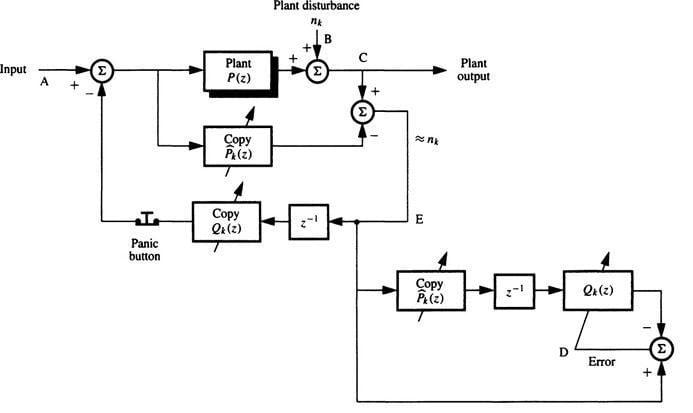
8.0 INTRODUCTION Methods for controlling plant dynamics have been described in the previous chapters. These methods have no effect on plant disturbance, which would simply appear unimpeded at the plant output. A feedback scheme for plant disturbance canceling which does not alter plant dynamics is suggested in Figs. 1.4 and 1.5. The purpose of this chapter is to develop plant disturbance canceling techniques based on this scheme. The goal is to minimize plant output disturbance power without changing plant dynamics. In control theory, it is most common to control plant response and plant disturbance in one process. With adaptive inverse control, however, it is convenient to treat these problems independently. In this way, the dynamic control process is not compromised by the need to reduce plant disturbance. Furthermore, the plant disturbance reduction process is not compromised by the needs of dynamic control. A plant disturbance canceling system is diagrammed in Fig. 8.1. Disturbance cancelation is accomplished by this system in the following manner. A copy of
Figure 8.1 An adaptive system for canceling plant disturbance. The system of Fig. 8.1 is comprised of two parts. One part does the actual disturbance canceling. The other part performs the inverse modeling of The adaptive plant disturbance canceler of Fig. 8.1 differs markedly from the conventional adaptive noise canceler described in Chapter 3 and illustrated in Fig. 3.8. The conventional noise canceler gets its noise reference signal externally and uses it for canceling by feedforward filtering and subtracting. The plant disturbance canceler gets its disturbance reference from the plant output and uses it for canceling by feedback filtering and subtracting from the plant input. It tries to cancel out its own disturbance reference signal. Nothing like this happens with the conventional adaptive noise canceler. The adaptive plant disturbance canceler represents a wholly new concept in noise canceling for a completely different type of noise (disturbance) control problem.
1 2 In physical systems where the plant is analog, if the plant has more poles in the s-plane than zeros, the discretized form of the plant, P(z), would have at least a unit delay in its response to an impulse input. As such, the unit delay in line with Qk(z) would be unnecessary and should be left out. Including it would cause a loss in performance. |
 k(z), a very close, disturbance-free match1 to P(z), is fed the same input as the plant P(z). The difference between the disturbed output of the plant and the disturbance-free output of