Analysis and Deformulation of Polymeric Materials: Paints, Plastics, Adhesives, and Inks
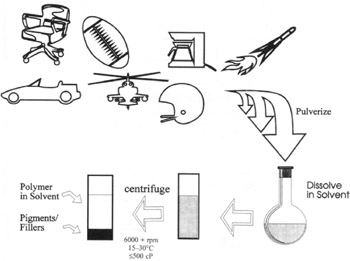
Solid specimens of plastic or polymeric materials usually consist of less than 5% by weight of pigments and fillers, the remainder being polymers. Small amounts of additives may be present. A scheme for the preliminary preparation of solid specimens is shown in Fig. 9.1. Most plastic products and related materials are not heavily pigmented or filled, with some exceptions. A thin section cut from these materials will usually suffice for IR analysis to provide an identification of the plastic material.
Krause et al. (1979) discusses identification of plastics by combustibility and solubility properties. An effective and economical method of preparing a plastic specimen for SEM analysis is to freeze the specimen in liquid nitrogen, which will cause it to become brittle. The brittle specimen will break by bending and provide a fresh surface for analysis.
If a surface for very detailed analysis is needed, mount the specimen in a liquid resin, which hardens, followed by polishing with grit to provide a very smooth and flat surface. Images on a smooth polished surface are more easily resolved forSEM, EDXRA, ESCA, AES, and SIMS analyses.
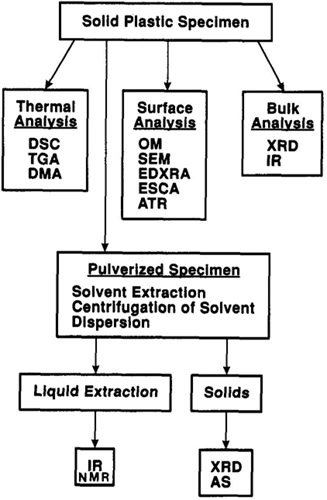
A detailed scheme for deformulation of solid plastic specimens is shown in Fig. 9.2. Often, the chemical class of the plastic material is identified by IR if there is no interference from heavy loading of pigments orfillers.
A plastic film specimen is hardened...