Analysis and Deformulation of Polymeric Materials: Paints, Plastics, Adhesives, and Inks
Adhesives can be pigmented, filled, but most are translucent or transparent. Materials are added to adhesive formulations for the following major purposes:
Enhanced adhesion
Wetting of substrates
Weathering, moisture resistance, etc.
Enhanced strength
Enhanced curing rate
Color
The formulations in Chapter 11 are examples of mixing ingredients to achieve a specific adhesive formulation for one ormore applications. Knowing either the type of adhesive or the application gives valuable clues about the other. If neither type norapplication is known, it is necessary to start from the beginning and use a proven deformulation scheme.
The following discussion covers methods for the deformulation of solid and liquid adhesive specimens. The methods of analysis are notexplained in detail as they were outlined individually in Chapters 2 and 3.
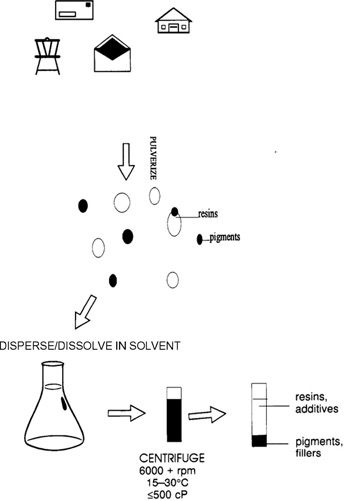
Some common sources of solid adhesive materials are shown in Fig. 12.1. The adhesive material is solid, and may be rubbery, after it sets up on the substrate. Solid specimens of adhesive materials are dried/cured cements, glues, hotmelt adhesives, and others. Taking a representative sample includes scraping off or cutting a specimen from a substrate. Usually, the solid sample is taken from an application where the adhesive was used.
Preparation of a solid specimen for investigation is illustrated in Fig. 12.1, and the solid specimen is pulverized by freezing with liquid nitrogen followed by hammering. A pulverized specimen will consist of fine particles which are...