Analyzing Uncertainty in Civil Engineering

2: Pilot Study

2 Pilot Study

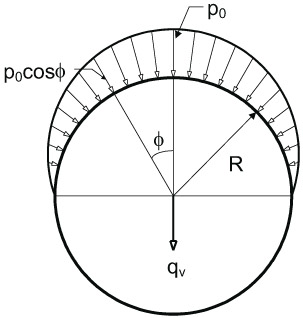
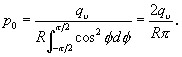
First of all, in order to determine the most critical regions of pile-supported pipelines and to gain better insight into the collapse mechanism of such structures, a three-dimensional FE-analysis was carried out using the general purpose program ABAQUS [11]. Taking advantage of symmetry, two adjacent pipe segments are modelled with solid and beam elements, respectively. To model the coupling, a beam-to-solid submodelling technique was used. The loading on the pipes was assumed to be equally distributed in axial direction. Fig. 3 shows the assumed distribution of the loading in the circumferential direction. For a given load q ?, contained for instance in codes [20], acting on the pipes per unit length in axial direction, one obtains the pressure p 0, acting at the crown of the pipes, as follows:


Figure 3: Assumed circumferential distribution of the loading.
(1)

The non-linear material behavior was approximated by a trilinear stress-strain relation. The contact between the saddle and the pipe and between the sleeve and the rubber sealing and the rubber sealing and the pipe, respectively, was accounted for in the numerical model. Three distinct locations were considered for a potential collapse:

  • the pipe in the vicinity of the support,

  • the sleeve connection,

  • the section of the pipe with the largest bending moment.

Summarizing briefly the key results of the pilot study, it can be concluded that the pipe collapses due to ovalization and wrinkling in the vicinity of support. Fig. 4 shows that the maximum...

UNLIMITED FREE
ACCESS
TO THE WORLD'S BEST IDEAS

SUBMIT
Already a GlobalSpec user? Log in.

This is embarrasing...

An error occurred while processing the form. Please try again in a few minutes.

Customize Your GlobalSpec Experience

Category: Plastic Pipe
Finish!
Privacy Policy

This is embarrasing...

An error occurred while processing the form. Please try again in a few minutes.