6.1 Probabilistic Design Approach
Probabilistic methods for the analysis and design of structures taking into account uncertainties of the geometry, the material behavior, the loading and, consequently, of the structural response, disclose possibilities for a theoretical foundation of existing standard design methods and the development of new, more economic design methods [1, 2, 6, 18]. Commonly, the design of a structure requires the consideration of the following limit states:
-
ultimate limit states corresponding to collapse or other types of structural failure and
-
serviceability limit states corresponding to specified service requirements for a structure (e.g. deformations affecting the use of a structure).
In the context of this study, the ultimate limit state is identified as failure of the pile-supported pipeline, which is induced by failure of the pipe in the vicinity of the support on the pile. The serviceability limit state is defined by an allowable limit of the ovalization of the pipe.
The design problem is usually formulated in the form of a critical inequality:
| (19) | 
|
where S and R are two random variables which represent a generalized action and a generalized resistance. In other words, the probability of failure P fail is given by the probability of violating the critical inequality
| (20) | 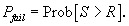
|
The basic design condition is to verify
| (21) | 
|
P f being a sufficiently small number which is established in the codes (for sewer systems usually 10 -5 ? P f ? 10 -3


 TABLE OF CONTENTS