Analyzing Uncertainty in Civil Engineering

3: Laboratory Tests

3 Laboratory Tests

3.1 Test Set-Up

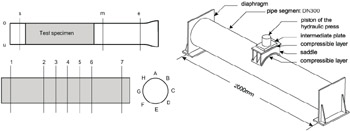
For the validation of the numerical model two series of tests were carried out in a load frame investigating the behavior of a pipe segment in the region close to the support on the pile (Fig. 6). Regarding the assessment of geometric imperfections, the wall thickness and the thickness of the casting skin, respectively, were measured at cross-sections 1-7 (Fig. 6) prior to testing. Taking cutouts from cross-sections s, m and e at locations o and u, six specimens per pipe with standard geometries according to DIN standards were prepared to determine stress-strain curves for tension and compression loading. Strain gages were installed at the outer surface of the pipe segment to measure longitudinal as well as circumferential strains. Inductive pickups were used to measure the change of diameter and the deflection of the pipe during the experiment. The force applied by the piston of the hydraulic press, simulating the pile force transmitted from the pile to the pipe, was increased in a displacement controlled manner. Note that in the lab tests the pile is simulated by the piston of the load frame. Hence, the test set-up is rotated by 180 with respect to a pile-supported pipeline. The data acquisition system was a low speed scanner with a rate of 1 sample per second. The total number of channels was 20, each channel corresponding to a displacement transducer and a strain gage, respectively.


Figure 6: Pipe segments and test...

UNLIMITED FREE
ACCESS
TO THE WORLD'S BEST IDEAS

SUBMIT
Already a GlobalSpec user? Log in.

This is embarrasing...

An error occurred while processing the form. Please try again in a few minutes.

Customize Your GlobalSpec Experience

Category: Drill Pipe
Finish!
Privacy Policy

This is embarrasing...

An error occurred while processing the form. Please try again in a few minutes.