Current Sources & Voltage References

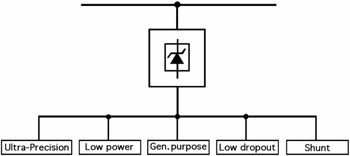
Since the introduction of the discrete zener diode in the early 1960s, monolithic voltage references have evolved over many generations, so that today they are available in various distinct categories. These include the bandgap, the buried-zener, the XFET from Analog Devices, along with the FGA from Xicor/Intersil. IC voltage references are now manufactured using various different processes (e.g., bipolar-FET, complementary-bipolar, bipolar-CMOS, CMOS), which has brought about lower noise, improved initial accuracy, smaller chips and packages, and lower-power devices. As a result, today's voltage references can be subdivided into different types that include shunt, general-purpose, low-dropout, low-power, and ultra-precision types. A diagram showing the different types of voltage references is shown in Figure 14.1. Typically, voltage reference ICs are fixed single devices, but a few dual devices are available. Some devices also have extra features for higher-performance applications. Some even allow one to select the reference voltage, trim it, filter it, and put it to sleep. Chapter 12 covered the reference's more important characteristics, so in this one we take a closer look at the different types and explore the merits of each.
While working on further op amp development at National Semiconductor in the late 1960s, the legendary Bob Widlar began looking into the subject of the silicon bandgap (V go) and how currents and voltages were dependent on absolute temperature (today we refer to these as I PTAT and V PTAT