Current Sources & Voltage References

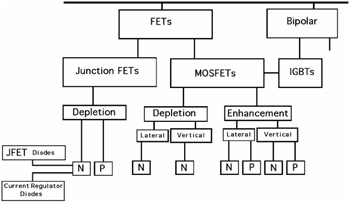
Just as BJTs can be used to create current sources, so too can field-effect transistors. The designer can readily utilize junction FETs (JFETs) and complementary metal oxide semiconductor (CMOS) FETs in low current-source applications. Alternately, one can use double-diffused MOS (DMOS) FETs for higher current requirements. However, these types of devices are often overlooked by the OEM board-level designer, because of their somewhat unfamiliar terminology, as opposed to the wide-scale popularity of the bipolar junction transistor (BJT). Actually, use of the FET can often render a simpler and less costly circuit, if one understands some of the critical parameters involved, rather than using more expensive solutions. These might include using op amps with voltage references or matched bipolar transistors, as discussed previously. Although it is a little more complex than is depicted here, because of process differences (e.g., silicon gate, metal gate, vertical, double-diffused), the basic FET family tree is shown in Figure 6.1. Not all FET versions are available or easy to manufacture. For example, you can see from the diagram that JFETs only function in the depletion mode, and P-channel depletion-mode MOSFETs are unavailable.
The basic theoretical principles of the FET were outlined in various papers published in the late 1920s by a German-born physicist, Dr. Julius E. Lilienfeld. He was granted a patent by the U.S. Patent Office in 1930. Some 17 years later, Dr. Shockley and his colleagues at AT&T's Bell Labs further...