Embedded Media Processing

Covering the entire spectrum of EMP-related design issues, this practical book will be an invaluable aid to every engineer working with EMP, from the beginner to the seasoned expert.
 TABLE OF CONTENTS
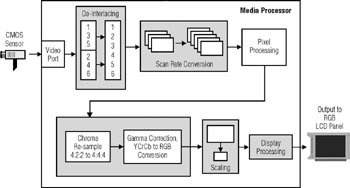
 Let's walk through the sample system of Figure 6.23 to illustrate some fundamental video processing steps present in various combinations in an embedded video application. In the diagram, an interlaced-scan CMOS sensor sends a 4:2:2 YCbCr video stream through the processor's video port, at which point it is deinterlaced and scan-rate converted. Then it passes through some computational algorithm(s) and is prepared for output to an LCD panel. This preparation involves chroma resampling, gamma correction, color conversion, scaling, blending with graphics, and packing into the appropriate output format for display on the LCD panel. Note that this system is only provided as an example, and not all of these components are necessary in a given system. Additionally, these steps may occur in different order than shown here.
When taking video source data from a camera that outputs interlaced NTSC data, it's often necessary to deinterlace it so that the odd and even lines are interleaved in memory, instead of being located in two separate field buffers. Deinterlacing is not only needed for efficient block-based video processing, but also for displaying interlaced video in progressive format (for instance, on an LCD panel). There are many ways to deinterlace, each with its own benefits and drawbacks. We'll review some methods here, but for a good discussion of deinterlacing approaches, refer to Reference 45 in the Appendix.
Perhaps the most obvious solution would be...