Embedded Media Processing

Covering the entire spectrum of EMP-related design issues, this practical book will be an invaluable aid to every engineer working with EMP, from the beginner to the seasoned expert.
 TABLE OF CONTENTS
 Figure 6.12 shows a typical end-to-end embedded digital video system. In one case, a video source feeds into a media processor (after being digitized by a video decoder, if necessary). There, it might be compressed via a software encoder before being stored locally or sent over the network.
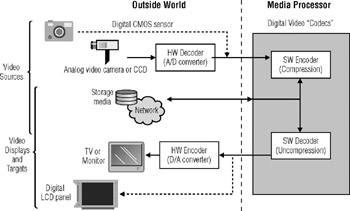
In an opposite flow, a compressed stream is retrieved from a network or from mass storage. It is then decompressed via a software decoder and sent directly to a digital output display (like a TFT-LCD panel), or perhaps it is instead converted to analog form by a video encoder for display on a conventional CRT.
Keep in mind that compression and decompression represent only a subset of possible video processing algorithms that might run on the media processor. Still, for our purposes, they set a convenient template for discussion. Let's examine in more detail the video-specific portions of these data flows.
A video decoder chip converts an analog video signal (e.g., NTSC, PAL, CVBS, S-Video) into a digital form (usually of the ITU-R BT.601/656 YCbCr or RGB variety). This is a complex, multi-stage process. It involves extracting timing information from the input, separating luma from chroma, separating chroma into Cr and Cb components, sampling the output data, and arranging it into the appropriate format. A serial interface such as SPI or I 2C configure the decoder's operating parameters. Figure 6.13 shows...