Handbook of Nanophase and Nanostructured Materials, Volume 2: Characterization
2.10: Energy Dispersive X-ray Microanalysis (EDS)

2.10 Energy Dispersive X-ray Microanalysis (EDS)

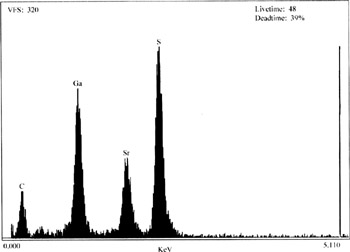
X-rays emitted from atoms represent the characteristics of the elements, and their intensity distribution represents the thickness-projected atom densities in the specimen. This is the energy dispersive X-ray spectroscopy (EDS), which has played an important role in microanalysis, particularly for heavier elements (Goldstein, et al., 1992). EDS is a key tool for identifying the chemical composition of a specimen. A modern TEM is capable of producing a fine electron probe of smaller than 2 nm, allowing direct identifi cation of the local composition of an individual nanocrystal. Shown in Fig. 2.54 is an EDS spectra acquired from a sample of nanocrystalline Ga-Sr-S. The peak intensity is directly related to the chemical composition of the corresponding element. Quantitative analysis gives Sr : Ga : S = 14 : 26 : 60, e.g., SrGa 2S 4. Detailed procedures can be found in Goldstein et al. (1992).


Figure 2.54: EDS spectrum acquired from a specimen of Ga-Sr-S

UNLIMITED FREE
ACCESS
TO THE WORLD'S BEST IDEAS

SUBMIT
Already a GlobalSpec user? Log in.

This is embarrasing...

An error occurred while processing the form. Please try again in a few minutes.

Customize Your GlobalSpec Experience

Category: X-Ray Fluorescence Spectrometers
Finish!
Privacy Policy

This is embarrasing...

An error occurred while processing the form. Please try again in a few minutes.