Hazardous Chemicals Handbook, Second Edition

The main chemical elements are listed in Chapter 18. Each comprises a nucleus of positively-charged protons and neutral neutrons orbited by negative electrons. The mass number A is given by
| where | Z is the number of protons, or atomic number |
| N is the number of neutrons. |
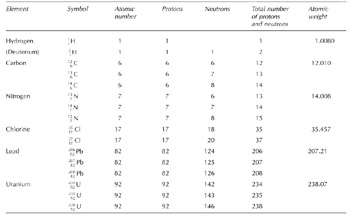
Atoms with the same value of Z but different values of A are isotopes (Table 11.1). Many isotopes are stable but others are naturally or artificially radioactive, i.e. their atomic nuclei disintegrate, emitting particles or radiation. This changes the nuclear structure of the atom and often results in the production of a different element.
|
![]() |
Natural sources of ionizing radiation include cosmic rays and nucleides such as potassium-40, carbon-14 and isotopes of thorium and uranium which are present in rocks, earth and building materials. Industrial sources of radiation include nuclear reactors, X-ray radiography, electron microscopy, X-ray diffractors, thickness gauges, smoke detectors, electron beam welding and certain processes including chemical analysis, polymer curing, chemical/biological tracing, food and medical sterilization, and mining. The radiation source can be sealed, when the radiation can be switched off, or unsealed. Examples of the former are smoke detectors and electrical devices for producing radiation.
The chemistry, and hence hazards, of 'hot', or radioactive, elements parallel those of their 'cold' isotopes. However, the radiation poses additional toxicity hazards. A qualitative classification of selected isotopes in terms of toxicity is given in Table 11.2. The biological effects of...