IPv6: The Next Generation Internet Protocol
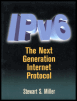
A practical, hands-on guide to the new version of the Internet Protocol, written for network administrators and managers who will work with IPv6.
 TABLE OF CONTENTS
 Standard IPv6 Neighbor Discovery and Address Autoconfiguration were designated for use over subnetworks where the fundamental media has a native broadcast capability. Non-Broadcast Multiple Access (NBMA) subnetworks don't have a native broadcast capability, however they are capable of concurrent connections to various nodes on an individual NBMA logical link.
The NBMA Next-Hop Resolution Protocol (NHRP) yields link-layer address resolution capability over NBMA logical links within a network-layer independent method. NHRP also provides a key function that dynamically discovers and resolves the address of the closest exit for the router of the node affiliated with a target address beyond the NBMA network section.
In this chapter we will look at the way in which IPv6 operates over NBMA media and how it depends on the use of NHRP to yield IPv6 Neighbor Discovery and IPv6 Address Autoconfiguration support. ICMPv6 messages are initially designated for standard IPv6 Neighbor Discovery, they are used for NBMA logical links. The standard IPv6 Neighbor Discovery operation is not used again because NBMA environments are beyond the area of the protocol.
The IPv6 interface token is utilized when auto-configuring an IPv6 address on a network interface. IPv6 addresses are constrained to logical network interfaces as opposed to being constrained to nodes.
Duplicate Address Detection is executed with a small improvement to the NHRP protocol. The Next-Hop Resolution Protocol (NHRP) was created to provide link-layer address resolution capabilities across NBMA logical links in a network-layer independent manner. NHRP has an important discovery...