The MPEG Handbook: MPEG-1, MPEG-2, MPEG-4, Second Edition

MPEG is actually an acronym for the Moving Pictures Experts Group which was formed by the ISO (International Standards Organization) to set standards for audio and video compression and transmission.
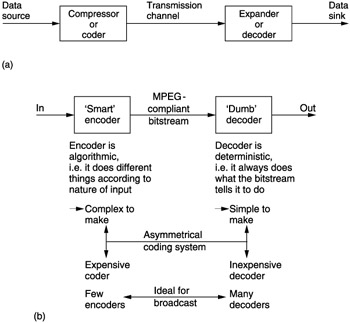
Compression is summarized in Figure 1.1. It will be seen in (a) that the data rate is reduced at source by the compressor. The compressed data are then passed through a communication channel and returned to the original rate by the expander. The ratio between the source data rate and the channel data rate is called the compression factor. The term coding gain is also used. Sometimes a compressor and expander in series are referred to as a compander. The compressor may equally well be referred to as a coder and the expander a decoder in which case the tandem pair may be called a codec.
Where the encoder is more complex than the decoder, the system is said to be asymmetrical. Figure 1.1(b) shows that MPEG works in this way. The encoder needs to be algorithmic or adaptive whereas the decoder is 'dumb' and carries out fixed actions. This is advantageous in applications such as broadcasting where the number of expensive complex...