The MPEG Handbook: MPEG-1, MPEG-2, MPEG-4, Second Edition

5.4: Colour Vision

5.4 Colour Vision

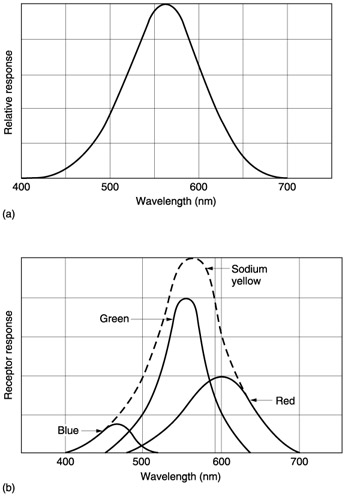
Colour vision is due to the cones on the retina which occur in three different types, responding to different colours. Figure 5.11 shows that human vision is restricted to a range of light wavelengths from 400 nanometres to 700 nanometres. Shorter wavelengths are called ultraviolet and longer wavelengths are called infra-red. Note that the response is not uniform, but peaks in the area of green. The response to blue is very poor and makes a nonsense of the use of blue lights on emergency vehicles which owe much to tradition and little to psycho-optics.


Figure 5.11: (a) The response of the eye to various wavelengths. There is a pronounced peak in the green region. (b) The different types of cone in the eye have the approximate responses shown here which allow colour vision.

Figure 5.11 shows an approximate response for each of the three types of cone. If light of a single wavelength is observed, the relative responses of the three sensors allow us to discern what we call the colour of the light. Note that at both ends of the visible spectrum there are areas in which only one receptor responds; all colours in those areas look the same. There is a great deal of variation in receptor response from one individual to the next and the curves used in television are the average of a great many tests. In a surprising number of people the single receptor zones are extended and discrimination between, for example,...

UNLIMITED FREE
ACCESS
TO THE WORLD'S BEST IDEAS

SUBMIT
Already a GlobalSpec user? Log in.

This is embarrasing...

An error occurred while processing the form. Please try again in a few minutes.

Customize Your GlobalSpec Experience

Category: Optical Filters
Finish!
Privacy Policy

This is embarrasing...

An error occurred while processing the form. Please try again in a few minutes.