The MPEG Handbook: MPEG-1, MPEG-2, MPEG-4, Second Edition

As the eye uses involuntary tracking at all times, the criterion for measuring the definition of moving-image portrayal systems has to be dynamic resolution, defined as the apparent resolution perceived by the viewer in an object moving within the limits of accurate eye tracking. The traditional metric of static resolution in film and television has to be abandoned as unrepresentative of the subjective results.
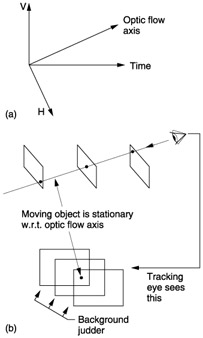
Figure 5.7(a) shows that when the moving eye tracks an object on the screen, the viewer is watching with respect to the optic flow axis, not the time axis, and these are not parallel when there is motion. The optic flow axis is defined as an imaginary axis in the spatio-temporal volume which joins the same points on objects in successive frames. Clearly when many objects move independently there will be one optic flow axis for each.
The optic flow axis is identified by motion-compensated standards convertors to eliminate judder and also by MPEG compressors because the greatest similarity from one picture to the next is along that axis. The success of these devices is testimony to the importance of the theory.
According to sampling theory, a sampling system cannot properly convey frequencies beyond half...