The MPEG Handbook: MPEG-1, MPEG-2, MPEG-4, Second Edition

5.1: The Eye

5.1 The Eye

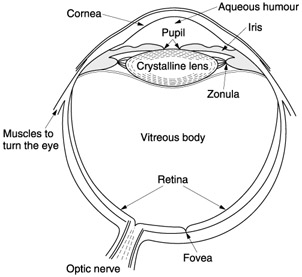
All imaging signals ultimately excite some response in the eye and the viewer can only describe the result subjectively. Familiarity with the functioning and limitations of the eye is essential to an understanding of image compression. The simple representation of Figure 5.1 shows that the eyeball is nearly spherical and is swivelled by muscles. The space between the cornea and the lens is filled with transparent fluid known as aqueous humour. The remainder of the eyeball is filled with a transparent jelly known as vitreous humour. Light enters the cornea, and the amount of light admitted is controlled by the pupil in the iris. Light entering is involuntarily focused on the retina by the lens in a process called visual accommodation. The lens is the only part of the eye which is not nourished by the bloodstream and its centre is technically dead. In a young person the lens is flexible and muscles distort it to perform the focusing action. In old age the lens loses some flexibility and causes presbyopia or limited accommodation. In some people the length of the eyeball is incorrect resulting in myopia (short-sightedness) or hypermetropia (long-sightedness). The cornea should have the same curvature in all meridia, and if this is not the case, astigmatism results.


Figure 5.1: The eyeball is in effect a living camera except for the lens that receives no blood supply and is technically dead.

The retina is responsible for light sensing...

UNLIMITED FREE
ACCESS
TO THE WORLD'S BEST IDEAS

SUBMIT
Already a GlobalSpec user? Log in.

This is embarrasing...

An error occurred while processing the form. Please try again in a few minutes.

Customize Your GlobalSpec Experience

Category: Magnifiers
Finish!
Privacy Policy

This is embarrasing...

An error occurred while processing the form. Please try again in a few minutes.