MPEG Video Compression Standard

Chapter 3: The Discrete Cosine Transform

In this chapter we present a review of the discrete cosine transform (DCT). This is an essential part of the MPEG standard, and must be understood if the reader is to make much sense of the chapters that follow. The treatment will, as much as possible, be nonmathematical and intuitive. We will first review the DCT from an intuitive graphical perspective; we then will briefly present the mathematics. Readers interested in more advanced topics such as fast DCTs may want to read [PM93] and [RY90].

The important topic of IDCT mismatch will not be covered in any detail until Chapter 12; at that point the reader will be familiar with the MPEG Standard pseudocode formalism used there.

3.1 The one-dimensional cosine transform

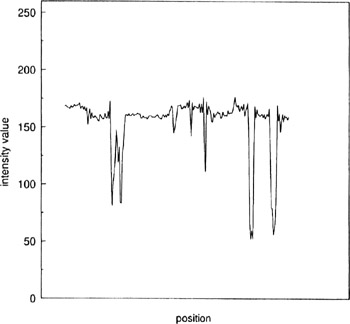
A video picture normally has relatively complex variations in signal amplitude as a function of distance across the screen, as illustrated in Figure 3.1. It is possible, however, to express this complex variation as a sum of simple oscillatory sine or cosine waveforms that have the general behavior shown in Figure 3.2(b). The sine or cosine waveforms must have the right spatial frequencies and amplitudes in order for the sum to exactly match the signal variations. When the waveforms are cosine functions, the summation is a cosine transform, the main topic of this chapter. When the waveforms are sine functions, the summation is another transform called the sine transform. The waveforms that make up these transforms are called basis functions.


Figure 3.1: An example of...

UNLIMITED FREE
ACCESS
TO THE WORLD'S BEST IDEAS

SUBMIT
Already a GlobalSpec user? Log in.

This is embarrasing...

An error occurred while processing the form. Please try again in a few minutes.

Customize Your GlobalSpec Experience

Category: IC Signal Generators
Finish!
Privacy Policy

This is embarrasing...

An error occurred while processing the form. Please try again in a few minutes.