The MXF Book

Written by a top team of industry professionals, this must-have guide introduces and explains the MXF standard, helps engineers write MXF applications, and explains the reasons behind many details of the specification documents.
 TABLE OF CONTENTS
 Definition: Key Length Value (KLV) coding is the lowest level protocol for encapsulating data in MXF. It is defined by SMPTE 336M.
Description: Key Length Value coding is the lowest level coding used in MXF. Each and every element, property, set, and thing in MXF is KLV coded in one way or another. Figure 3.14 shows the structure of a KLV key. It is composed of 16 bytes and should be treated as a dumb number.
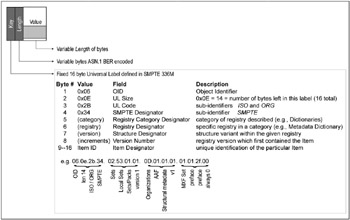
It is important to note that when an MXF parser is in KLV context i.e., it is expecting a KLV key there are times when byte 9 will not have the value 0D h. This is because the defined key may well be the definition of a private KLV triplet. Figure 3.15 shows an example of a private KLV triplet being inserted between two known MXF triplets.
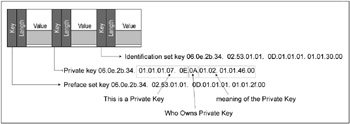
The private KLV triplet allows companies and organizations who have registered their own number spaces with SMPTE to be able to define structure (sets and groups) as well as individual KLV properties. Only two of the set coding schemes defined in SMPTE 336M are used in the MXF specification local sets, and defined- (fixed-) length packs.
Local set coding replaces 16-byte keys with 2-byte tags to reduce the amount of space required to create a KLV triplet. In MXF, 2-byte length values are used in local set...