The MXF Book

Written by a top team of industry professionals, this must-have guide introduces and explains the MXF standard, helps engineers write MXF applications, and explains the reasons behind many details of the specification documents.
 TABLE OF CONTENTS
 Bruce Devlin
MXF categorizes essence into picture, sound, and data. Sound essence covers uncompressed and compressed audio whether it be mono, stereo, multi-channel, or multilingual. MXF is intended for the interchange of complete or finished material. Although MXF can represent cut edits, it is not intended to be a full audio editing language, nor is it intended to be a full N channels from M sources crossbar-routing language.
As you will have seen in other chapters, MXF describes essence by using tracks and references. Figure 6.1 on the next page shows a typical OP1a file.
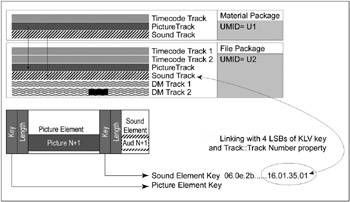
The material package sound track describes the output timeline that references the file package sound tracks. The file package sound track, in turn, is linked to a KLV element in the essence container via the FilePackage::SoundTrack::TrackNumber property, which will have the same value as the least significant 4 bytes of the KLV key. The actual essence is interleaved with the picture elements and is internal to the MXF file.
This referencing mechanism determines which audio content is played out. The subtlety comes in making it work in all the many and varied use cases that MXF addresses.
Before looking at specific audio examples, it is worth mentioning again the various MXF documents that are needed to understand audio:
SMPTE 377M The MXF File Format Specification. This describes the tools available for describing and synchronizing the sound essence.
SMPTE 379M The generic container specification.