Next Generation Wireless Networks

Focusing on the defining architectures, services and applications, this book is an organized and edited work of enabling technologies for the applications and services needed for future wireless networks.
Results for first passage times helped us to derive the bounds for the one-dimensional case. Since we were unable to find first passage time results for higher dimensions are not available in the literature, these results are provided here so that we may derive bounds on the average number of pieces delivered. We assume the same radio and links rate scenario as in the single dimensional case.
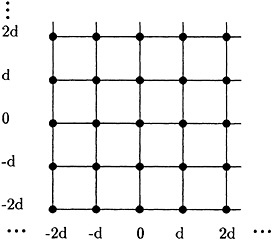
We first extend the one-dimensional case to two-dimensions. Let us consider that the infostations are equally spaced in a rectangular grid as shown in Figure 1.17. The mobile can go right, left, up or down with probabilities p r , p l , p u and p d , respectively. At every step the mobile chooses one direction and does not stay at the same position. The velocity is still assumed constant for internode moves.
We want to calculate the average number of file segments that can be picked up by step s,  . Let p(x, y, ts) be the probability that location (x, y) was last visited at time t
| (1.34) | 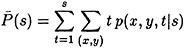 |
Observing the motion process backwards, as we did in the last section, then p(x, y, ts) is simply the probability that, starting at some position (n x , n y

 TABLE OF CONTENTS