Next Generation Wireless Networks
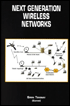
Focusing on the defining architectures, services and applications, this book is an organized and edited work of enabling technologies for the applications and services needed for future wireless networks.
Consider a one-dimensional model where users move along a line populated with equidistant infostations. Our objective is to derive lower bounds on information delivery delay. In the first section we study the case of constant velocity, where users move with a fixed velocity and fixed travel direction. In the second section we study the case where users travel with constant speed but random travel direction a one-dimensional random walk. This constant velocity model, although simple, covers important situations such as highway or railroad travel. Furthermore, it serves to illustrate some of the basic concepts of file delivery under the infostation model. In this section we assume that information can be delivered from the backbone to the clusters at or above the backbone rate and that likewise, the radios are speedy enough that were an entire file available at the infostation, it could be downloaded during one passage through the coverage area.
Consider a system with many infostations equally spaced at distance d meters, as shown in Figure 1.12. Assume that the mobile travels at constant velocity ? m/s, the size of the coverage area is d c and that the wired backbone transmits at a rate of R b
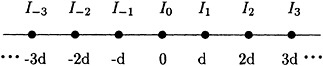
The mobile will arrive in a given infostation and request a file of size F bits. If
| (1.1) |  |
then the mobile can receive only a part of the...

 TABLE OF CONTENTS