Next Generation Wireless Networks
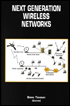
Focusing on the defining architectures, services and applications, this book is an organized and edited work of enabling technologies for the applications and services needed for future wireless networks.
In this work we considered the problem of delivering a file in system which features high rate discontinuous coverage. The collection of access points and the algorithms which support file delivery we call an infostation System. Assuming that there are several infostations in the mobile path, the file is divided into segments and different segments can be transmitted to different infostations along the path.
The constant velocity case was studied and the most interesting result is that higher mobile velocity reduces delay if different data can be delivered to multiple infostations in parallel over the fixed network. Then a random walk mobility model was introduced with constant velocity but with randomly chosen travel direction at each step. Results for bounds on the average number of file segments picked after a given number of steps for a general infostations topology were obtained. It was shown that the fewer infostations are revisited in a path, the larger the average number of segments obtained at each step.
An algorithm for the one-dimensional case was proposed. The algorithm simply tries to avoid repetitions of segments in places where the mobile is likely to visit along a path. The algorithm is not optimum in the sense that it does not achieve the absolute bound associated with foreknowledge of the user path, and it fails when it cannot avoid the repetitions. However, it is an open question whether this algorithm is indeed optimal among...

 TABLE OF CONTENTS