Next Generation Wireless Networks
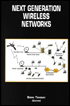
Focusing on the defining architectures, services and applications, this book is an organized and edited work of enabling technologies for the applications and services needed for future wireless networks.
BOB RICHTON, GIOVANNI VANNUCCI, AND STEPHEN WILKUS
Lucent Technologies/Bell Laboratories, Whippany, NJ, USA
Many approaches have been advanced for locating the geographic position of wireless phones, both for emergency response purposes and for emerging location-based services. Depending mainly upon the services envisioned and the particulars of the air interface, one or another approach appears appealing,. Increasingly, the assisted-GPS approach is gaining recognition as the approach that can best meet all requirements. Among the important requirements are those mandated in the USA by the Federal Communications Commission (FCC) for Enhanced 911. Assisted GPS provides the best accuracy for use in location services. It is rooted in the suitability of wireless networks to provide data over the air to enable fast acquisition and lower power consumption, as well as provide indoor operation capabilities that conventional GPS cannot provide. The assisted-GPS approach promises to enable a new industry of location-based services and important new safety measures.
cellular systems, geolocation, standards, wireless location, assisted-GPS, FLT, E-OTD, observed time difference of arrival, IS-801, WAG, FINDS.
By now, the need for wireless geolocation [*] is well established. The need is driven in the USA largely by the Federal Communications Commission (FCC), which ruled that the location of a Mobile Station (MS) calling 911 must be provided to the Public Safety Answering Point (PSAP). Besides emergency services, many other geolocation-based applications have been described [1 ]. Among these applications are:
Location sensitive billing: Enabling price differentials based on the...

 TABLE OF CONTENTS