Nokia Network Security Solutions Handbook
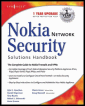
Your complete guide to Nokia IP network security solutions.
 TABLE OF CONTENTS
 As we saw in the "Understanding Configuration Options" section of Chapter 4, the NSP supports quite a few different dynamic routing protocols. Nokia developed its own code base for most of the various routing protocols (that were not licensed from other vendors) and bundled their functionality together in the IPSO routing daemon, or ipsrd.
The most commonly used of those dynamic routing protocols are RIP (v1 and v2), OSPF, and BGP (v4), all of which are supported by ipsrd. In this chapter we talk about each of these protocols in detail, first by going over the basic theory and functionality offered by each protocol, then by showing how it can be configured in Voyager. In the "Logging" section we talk about how to log various routing events and how to monitor dynamic routing protocols using the command-line tool iclid
Finally, we discuss the theory and implementation of a new feature in IPSO 3.5: VLAN-aware routing, otherwise known as VLAN tagging or 802.1Q.
RIP, which stands for Routing Information Protocol, is a very commonly used interior gateway protocol (IGP). IGPs, as opposed to exterior gateway protocols, distribute routing information within one autonomous system, such as your LAN.
RIP is a distance-vector protocol, meaning that it determines distance to other network devices by hop count. Hop count, which is stored in each TCP packet header, is simply the number of routers (or other devices, in some cases) a packet must traverse before reaching its final destination.
The...