Nokia Network Security Solutions Handbook
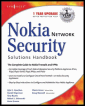
Your complete guide to Nokia IP network security solutions.
 TABLE OF CONTENTS
 Apart from the ease with which Voyager allows system configuration, it also allows the administrator to look inside the inner workings of the IPSO operating system to monitor various aspects of the Nokia appliance. While it is running, the operating system collects a wealth of information about dynamic data such as running processes, as well as CPU and memory usage. In addition, the operating system can also be queried for static data, such as interface configuration and status, or the kernel-forwarding table. This information gives a snapshot of the overall status and health of the Nokia appliance. To truly make sense of this data, one needs to have some indication of what his or her Nokia appliance looks like under normal conditions.
Static and dynamic monitoring features enable you to manage and maintain system availability. In some network environments, fault tolerance and network resiliency are critical elements within the organization. Nokia appliances offer a way to monitor state information for each interface that can help determine which Nokia appliance (in a high-availability setup) has failed and which Nokia appliance has been promoted to primary or demoted to backup status. Having access to this information is important in troubleshooting system and network problems.
Monitoring features can also be used to help troubleshoot potential routing issues with dynamic routing protocols with RIP, BGP, OSPF, or VRRP. Almost all network administrators and engineers experience some type of routing problem in their networks. These problems include routes not being advertised correctly, a firewall...