Physical Testing of Rubber
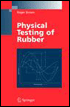
Primarily intended as a reference for those directly concerned with testing rubbers, this book provides comprehensive coverage of the procedures for measuring the whole range of the physical properties of rubber.
 TABLE OF CONTENTS
 Rubbers are by no means impermeable to vapours and gases, although in many cases the rate of transmission is low. In a number of applications even a small loss (or gain) of liquid or gas may be important, for example balloons, fuel tanks or water vapour barriers and, in consequence, the rate of transmission then needs to be measured.
The theoretical aspects of permeation through polymers have been considered in some detail in a very comprehensive review by Lomax [1], [2] and by Hands in Handbook of Polymer Testing [3]. Only the basic concepts are necessary here and Lomax's review and the chapter by Hands are recommended for a more detailed consideration of the subject. The review describes and comments on virtually all known test methods at the time as well as considering the theory and providing a bibliography of almost 100 references, whilst the book chapter has the same scope and provides more recent references.
[1]Lomax, M. Polym. Test., 1, No. 2, 1980
[2]Lomax, M. Polym. Test., 1, No. 3, 1980.
[3]Brown R P (Editor). Handbook of Polymer Testing, Marcel Dekker, New York, 1999.
Gas or liquid can flow through the holes in a porous material but, even if there is no porosity or flaws, permeation through the material will take place by a process of absorption and diffusion. In the ideal case, the quantity of gas or vapour being transmitted builds up to a constant steady state level...