Physical Testing of Rubber
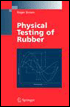
Primarily intended as a reference for those directly concerned with testing rubbers, this book provides comprehensive coverage of the procedures for measuring the whole range of the physical properties of rubber.
 TABLE OF CONTENTS
 Rubber is frequently used as a composite with other solids, for example in tyres, belting and coated fabrics, or may be in contact with other solids during use. The testing of composite materials or products containing rubber is, in general, outside the scope of this book but certain tests which are usually considered to be rubber tests are included here. These are adhesion to metals, adhesion to fabrics, adhesion to cord, corrosion of metals and paint staining.
Adhesives and adhesion are of course very large subjects that are by no means restricted to polymers, let alone rubbers. There are numerous test methods for characterizing and measuring the performance of adhesives which may be relevant to rubber but they are outside the scope of this chapter.
Rubber is bonded to metal during processing to form a variety of products and in most cases a very strong bond is necessary for the product to perform satisfactorily. It is usually desirable to measure bond strength by testing the actual product but this is not always possible or convenient and, particularly for evaluating bonding systems, there is a need for tests using standard laboratory prepared test pieces. Whether the product or a test piece is used, the bond should be strained in essentially the same manner as would occur in service, although this may be complex rather than, for example, in simple tension or shear.
Some possible modes of straining for laboratory test pieces are illustrated in Figure 18.1.