Physical Testing of Rubber

Primarily intended as a reference for those directly concerned with testing rubbers, this book provides comprehensive coverage of the procedures for measuring the whole range of the physical properties of rubber.
 TABLE OF CONTENTS
 Shear, like compression, is a more important mode of deformation for engineering applications than tension. Nevertheless, tension remains the most common mode for laboratory stress/strain tests and even less testing is carried out in shear than in compression. The two commonly used geometries for obtaining shear strain are simple shear and pure shear, which are described below. The practical drawback to testing in simple shear is the necessity to bond the rubber test piece to rigid members to provide attachments for applying the shearing force. For pure shear, very wide grips are needed and care taken to avoid slippage. These factors doubtless contribute to discourage testing in shear, although interest in pure shear has increased due to the need of input data for finite element analysis.
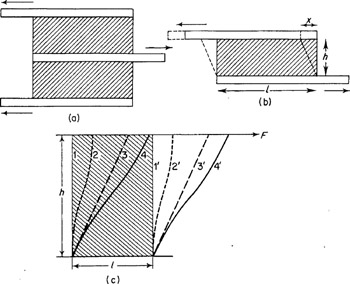
The stress/strain curve in simple shear is approximately linear up to relatively large strains and can be represented by:

where: F = applied force, A = cross-sectional area, G = shear modulus, and ? = shear strain.
With reference to Figure 8.16, the strain is x/h and area A is 1 x the width of the rubber (not shown in the diagram) for a single sandwich and twice this for the double sandwich.
If the ratio of...