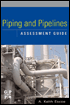
Piping and Pipelines Assessment Guide

Chapter 6: Piping Maintenance and Repairs

Leaking Pipe Flanges and Hot Bolting

This chapter is oriented to in-plant piping maintenance and repairs. The methodology can be applied to pipelines, especially the sections on sleeve design. However, new developments are in the offing (e.g., the ASME B31.4 Committee, "Pipeline Transportation Systems For Liquid Hydrocarbons and Other Liquids," has passed a new ballot, and passed by the B31 Committee, that states that neither patches or half soles shall be installed on pipelines). These changes should appear in the ASME B31.4 2005 edition.

Hot bolting herein means to tighten the bolts on a flange while it is in service. Hot bolting has been used to stop small stable leaks or as a proactive measure in high temperature (over 800 F or 427 C) or cyclic services where there are temperature changes over 300 F (149 C) in less than 30 minutes. The vast majority of flanges bolted together properly should never have to be hot bolted, and most sites that have good maintenance do not routinely hot bolt flanges that are not leaking. However, process excursions or experience over time may require scheduled hot bolting. If hot bolting is planned, consideration should be given to coating the studs and nuts with electroless nickel to minimize corrosion-related binding.

There are safety precautions that need to be adhered to before proceeding with bolt torque. If there are hydrocarbons or other combustible gases in the atmosphere, a wrench can (and has) initiated a spark that can set off an explosion. Hot bolting is rarely done under...

UNLIMITED FREE
ACCESS
TO THE WORLD'S BEST IDEAS

SUBMIT
Already a GlobalSpec user? Log in.

This is embarrasing...

An error occurred while processing the form. Please try again in a few minutes.

Customize Your GlobalSpec Experience

Category: Flow Switches
Finish!
Privacy Policy

This is embarrasing...

An error occurred while processing the form. Please try again in a few minutes.