Properties of Porous Silicon

H.J. von Bardeleben and J.L. Cantin
June 1997
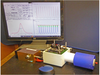
Electron paramagnetic resonance (EPR) spectroscopy is a powerful technique for quantitative defect analysis in solids and it has been applied in a large number of circumstances for the analysis of porous silicon samples [1]. A particular attribute of EPR spectroscopy is that the entire volume of typically mm 3 sized samples is analysed and absolute volume or area concentrations of defects can be determined. EPR spectra can also be measured by optical detection magnetic resonance (ODMR), which can give insight into the recombination process associated with the photoluminescence bands; however, absolute defect concentrations can no longer be obtained.
Porous silicon is generally prepared by electrochemical or chemical dissolution of n-type or p-type doped Czochralski grown silicon substrates. From these preparation conditions different types of defects can be expected to occur: the dopant atoms, which are believed to remain in the porous layer, can in principal be assessed, at least in the case of n-type dopants, by this technique. Apart from the thermally induced oxygen related defects (thermal donors), the concentration of other native point defects in the Si substrates has typical values of <10 12 cm -3, well below the detection limit, and thus such defects are not expected to occur in porous silicon. After preparation of the porous layers large surface areas are formed ( ? 200 m 2/cm 3), which can be a source for surface...