Six Sigma Best Practices: A Guide To Business Process Excellence For Diverse Industries

The rate of return in any business is critical for availability of capital. Investors will not tolerate returns below the returns of long-term government securities (adjusted upward by the risk of capital loss). Essential structural features of each industry determine the strength of competitive forces in that industry and, hence, overall industry profitability. The goal of a competitive strategy for a business unit in any industry is to find a position in the industry in which the company can best defend itself against competitive forces or can influence them in its favor. Business management understands the collective strength of competitive forces, and the results of competition are apparent. Studying and analyzing underlying sources of competitive forces are essential. Knowledge of the underlying sources of competitive pressure will highlight critical strengths and weaknesses of a company. Serious analysis of a company's position in its industry clarifies areas in which:
Strategic changes can yield the greatest payoff
Significant opportunities exist
Greatest threats exist
Competitive Forces
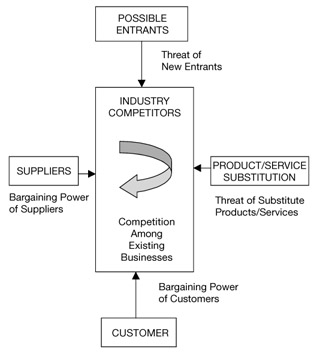
Five competitive forces are presented in Figure A1.1. A brief discussion will be presented for:
Threat of new entrants
Threat of substitute products/services/solutions
Bargaining power of customers
Bargaining power of suppliers
Competition among existing businesses
Analyzing and understanding these forces can result in:
Intensified competition
Business profitability
Strategy formulation
Consideration of areas for...