Water-Soluble Polymers: Solution Properties and Applications

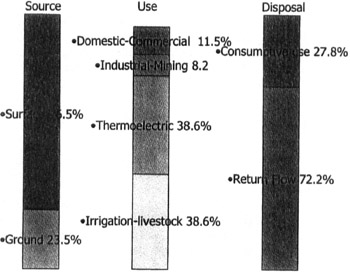
Water use in the United States and particularly in the arid Southwest, is rapidly increasing. Continued industrial growth, population growth, and power consumption all place demands on the finite quantity of water. Current large dependence on ground water is not sustainable. As there are no new sources of water, we must reallocate or conserve existing sources. Although irrigation, livestock, commercial and domestic use represent some of the largest consumers of water, the focus of this paper is on the thermoelectric power generation and industrial segments of water use. In these segments the non-consumptive use of water for cooling represents a potential for savings.
Steam electrical generation is the major consumer of water for cooling, but it has traditionally relied upon once-through cooling, rather than the use of wet cooling towers. This percentage has shrunk rapidly from 80% once-through in 1975 to a projected 60% in 2000. [1] The conversion to wet cooling towers and to dry cooling towers has had a major impact on water use for steam electrical generation. In the industrial segment, four industries consume the majority of water: pulp and paper, chemical processing, oil refining and primary metal manufacturing. Together, these segments represent 96% of all industrial water use. Greater than 70% of water demand was for cooling.
| Domestic use | Water for household needs such as washing clothes, bathing and watering lawns (also called residential water use). |
| Commercial use | Water for hotels, restaurants,... |