Administering Cisco QoS for IP Networks

Tweak and tune your Cisco routers for best performance with this practical guide.
 TABLE OF CONTENTS
 Now that we have explored the basic components of EIGRP, let s take a moment to discuss the packet types that establish the communications between EIGRP-speaking routers.
EIGRP implements five packet types:
All of these packets share the same packet header format shown in Figure 2.6.
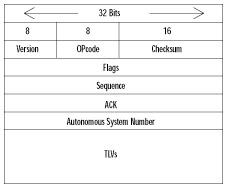
The particular packet type is specified in the OPcode field following the rules in Table 2.2.
| OPcode | Type |
|---|---|
| 1 | Update |
| 3 | Query |
| 4 | Reply |
| 5 | Hello |
| 6 | IPX SAP |
TLV stands for Type/Length/Value and contains the information used to share routing information. Type is specified as one of the two octet values listed in Table 2.3.
| Number | TLV Type |
|---|---|
| General TLV Types | |
| 0x0001 | EIGRP Parameters |
| 0x0003 | Sequence |
| 0x0004 | Software Version |
| 0x0005 | Next Multicast Sequence |
| IP-Specific TLV Types | |
| 0x0102 | IP Internal Routes |
| 0x0103 | IP External Routes |
| AppleTalk-Specific TLV Types | |
| 0x0202 | AppleTalk Internal Routes |
| 0x0203 | AppleTalk External Routes |
| 0x0204 | AppleTalk Cable Configuration |
| IPX-Specific TLV Types | |
| 0x0302 | IPX Internal Routes |
| 0x0303 | IPX External Routes |
Figure 2.7 gives the format of a General TLV. As you can see, this is...