Administering Cisco QoS for IP Networks

Tweak and tune your Cisco routers for best performance with this practical guide.
 TABLE OF CONTENTS
 While our small network has several strong points such as high levels of redundancy, it has begun to develop several problems. First, our addressing scheme is not very hierarchical and wastes high numbers of host addresses on the point-to-point links.
Second, without a dedicated Distribution layer, our Access and Core layer routers are going to be forced to share the duties that should be restricted to the Distribution layer. This will become more evident when we connect our accounting network to the rest of the corporate office and to remote sites.
Resolving the addressing issues is our most pressing need. We know that the network will grow rapidly, and if we allow the problem to continue it will quickly become unmanageable. When core routers are aware of all network segments, any flapping routes down at the Access layer will cause diffused computations that will spread to the core. We do not want our core routers wasting processing cycles attempting to recalculate routes that they really did not need to know about to begin with. To illustrate this point, we are going to add two more Access layer routers and complete our accounting department by adding a core router that will connect to the corporate office network. In Figure 2.21, we have added the new routers and cleaned up our router-naming scheme.
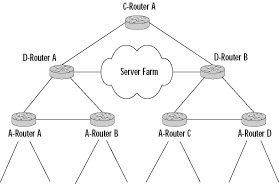
Routers that are designated as Core will begin with C-, Distribution routers will begin with D-, and Access...