Administering Cisco QoS for IP Networks

Tweak and tune your Cisco routers for best performance with this practical guide.
 TABLE OF CONTENTS
 Configuring EIGRP on small to medium-sized networks can be simple and straightforward. This often leads to the incorrect conclusion that EIGRP is a simple protocol as you have seen, this is not true. EIGRP processes are complex and must be kept in mind as your network is designed and ultimately implemented. In the next two sections, we discuss and design a increasingly complex network and see what design principals we should follow to allow an EIGRP network to adhere successfully to some basic tenants of routing:
EIGRP was designed with several key features to allow for these and several other principles to greatly improve network reliability and efficiency. While a comprehensive design guide full of case studies would occupy the complete volume of this text, we will attempt to demonstrate the most common implementations that are encountered in today s networks. The end result will hopefully allow you to use these examples in your successful design and implementation.
Enabling EIGRP is as straightforward as IGRP and RIP. The process is started with the router command, and participating networks are added with the network command. Figure 2.18 shows a three-router network that will function under the same EIGRP process.
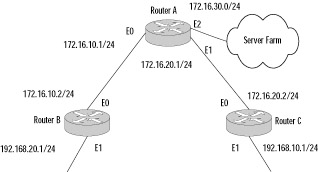
This simple network can be found as a piece...