Advanced Design Problems in Aerospace Engineering, Volume 1: Advanced Aerospace Systems

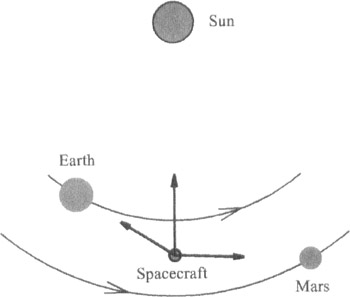
At every point of the trajectory, the spacecraft is subject to the gravitational attractions of Earth, Mars, and Sun. Therefore, we are in the presence of a four-body problem, the four bodies being the spacecraft, Earth, Mars, and Sun (Fig. 1a). Assuming that the Sun is fixed in space, the complete four-body model is described by 18 nonlinear ordinary differential equations (ODEs) in the three-dimensional case and by 12 nonlinear ODEs in the two-dimensional case (planar case). Two possible simplifications are described below.
This model consists in subdividing an Earth-to-Mars trajectory into three segments: a near-Earth segment in which Earth gravity is dominant; a deep interplanetary space segment in which Sun gravity is dominant; a near-Mars segment in which Mars gravity is dominant. Under this scenario, the four-body problem is replaced by a succession of two-body problems, each described in the planar case by four ODEs, for which analytical solutions are available. Then, the segmented solutions must be patched together in such a way that some continuity conditions are satisfied at the interface between contiguous segments.
Even though the method of patched conics has been widely used in the literature, our experience with it has been rather disappointing for the reason indicated below. Near the interface between contiguous segments, there is a small region in which two of the three gravitational attractions are of the same order. Neglecting one of them on each side of the interface...