Advanced Design Problems in Aerospace Engineering, Volume 1: Advanced Aerospace Systems

In this section, we present the results obtained by solving the mathematical programming problems of Section 6 with the algorithm of Section 7 in light of the planetary and mission data of Section 8.
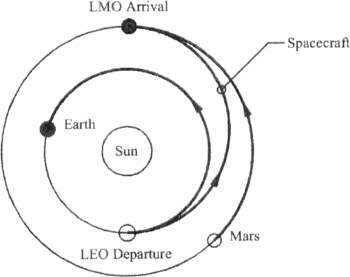
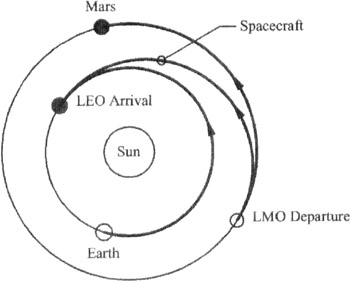
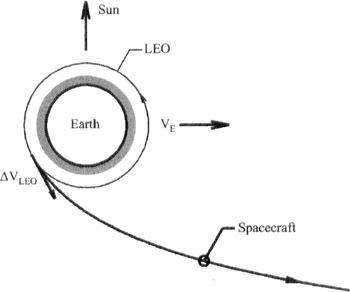
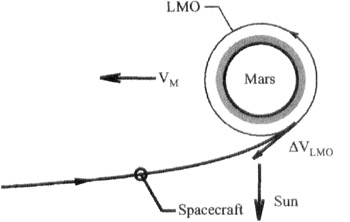
The optimal LEO-to-LMO trajectory is shown in Figs. 2 3.
Figure 2a refers to deep interplanetary space (Sun coordinates). The baseline optimal trajectory resembles a Hohmann transfer trajectory, but is not a Hohmann transfer trajectory, due to the disturbing influence of the gravitational fields of Earth and Mars on the terminal portions of the trajectory.
Figure 3a refers to near-Earth space (relative-to-Earth coordinates, first hour). The baseline optimal trajectory bends under the influence of the Earth gravitational field, tending to become parallel to the Earth trajectory at the end of near-Earth space. The asymptotic parallelism condition (hinted by Fig. 3a, but not shown in Fig. 3a) is reached toward the end of the first day (Earth gravitational attraction negligible w.r.t. Sun gravitational attraction). See [18].
Figure 3b refers to near-Mars space (relative-to-Mars coordinates, last hour). In reverse time, the baseline optimal trajectory bends under the influence of the Mars gravitational field, tending to become parallel to the Mars trajectory at the beginning of near-Mars space. The asymptotic parallelism condition (hinted by Fig.