Advanced Design Problems in Aerospace Engineering, Volume 1: Advanced Aerospace Systems

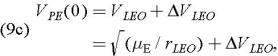
In polar coordinates, the spacecraft conditions at the departure from LEO (time t = 0) are given by
Relative to Earth r PE, ? PE, V PE, ? PE are the radial distance, phase angle, velocity, and path inclination of the spacecraft; V LEO is the spacecraft velocity in the low Earth orbit prior to application of the tangential, accelerating velocity impulse; ? V LEO is the accelerating velocity impulse at LEO; V PE(0) is the spacecraft velocity after application of the accelerating velocity impulse.
The corresponding equations in Cartesian coordinates are
with
Equation (11c) is an orthogonality condition between vec(EP(0)) and vec( V PE(0)), meaning that the accelerating velocity impulse ? V LEO is tangential to LEO.
In polar coordinates, the spacecraft conditions at the arrival to LMO (time t = ?) are given by
Relative to Mars r PM, ? PM, V PM, ? PM are the radial distance, phase angle, velocity, and path inclination of the spacecraft; V LMO is the spacecraft velocity in the low Mars orbit after application of the tangential, decelerating velocity impulse; ? V LMO is the decelerating velocity impulse at LMO; V PM( ?) is the spacecraft velocity before application of the decelerating velocity impulse.
The corresponding equations in Cartesian coordinates are
with
Equation (14c) is an orthogonality condition between vec(MP( ?