Advanced Design Problems in Aerospace Engineering, Volume 1: Advanced Aerospace Systems

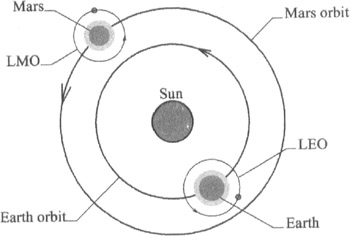
Let LEO denote a low Earth orbit, and let LMO denote a low Mars orbit. We study the LEO-to-LMO transfer [LMO-to-LEO transfer] of a spacecraft under the following scenario (Fig. 1b). Initially, the spacecraft moves in a circular orbit around Earth [Mars]; an accelerating velocity impulse is applied tangentially to LEO [LMO], and its magnitude is such that the spacecraft escapes from near-Earth [near-Mars] space into deep interplanetary space. Then, the spacecraft takes a long journey along an interplanetary orbit around the Sun, enters near-Mars [near-Earth] space, and reaches tangentially the low Mars orbit [low Earth orbit]. Here, a decelerating velocity impulse is applied tangentially to LMO [LEO] so as to achieve circularization of the motion around Mars [Earth].
The following hypotheses are employed: (A1) the Sun is fixed in space; (A2) Earth and Mars are subject only to the Sun gravity; (A3) the eccentricity of the Earth and Mars orbits around the Sun is neglected, implying circular planetary motions; (A4) the inclination of the Mars orbital plane vis- -vis the Earth orbital plane is neglected, implying planar spacecraft motion; (A5) the spacecraft is subject to the gravitational attractions of Earth, Mars, and Sun along the entire trajectory; (A6) for the outgoing and return trips, the class of two-impulse trajectories is considered, with the impulses being applied at the terminal points of the trajectories; (A7) for the outgoing and return trips, circularization of motion around the...