The Committed Enterprise: How to Make Vision and Values Work

This guide describes how to build unstoppable organizations, whether businesses or charities, hospitals or orchestras, by managing vision and values scientifically yet creatively.
 TABLE OF CONTENTS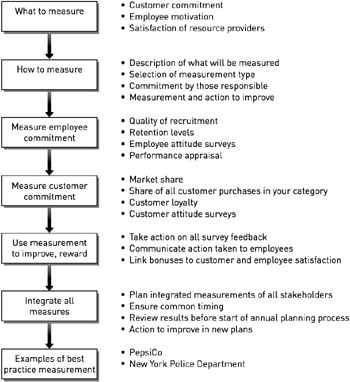
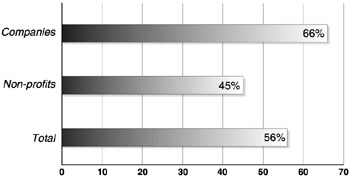
In our research, companies scored much better on best practice measures than non-profits (see Figure 11.1).
Many organizations performed unevenly, with, for instance, good measures for customer commitment, weak ones for employee motivation, and vice versa. Non-profits had less rigorous processes for measuring people, activities and results.
Why bother to measure vision and values? Because measures create consequences for good or poor performance, and provide a basis for improvement. They send out an important message to everyone: management is serious about making vision and values work. People will do what you measure. If you can't measure it, you can't manage it. [1]
Those who openly commit to measures for success at the outset of a programme are more likely to succeed, because they know their performance will be evaluated.
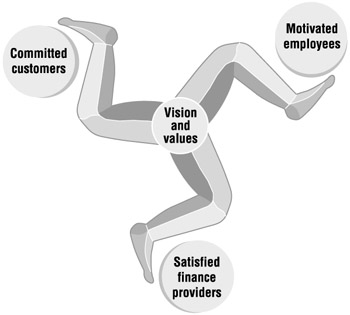
You are measuring whether you have succeeded in creating a Committed Enterprise. That means committed customers, motivated employees and satisfied resource providers, as Chart 11.1 reminds you. Of course there are other constituents, such as suppliers, partners and the general public, to be considered as well. But if you're on song with the main ones, the others will usually be satisfied.
[1]Interview with Sir Anthony Cleaver, Chairman, AEA Technology.
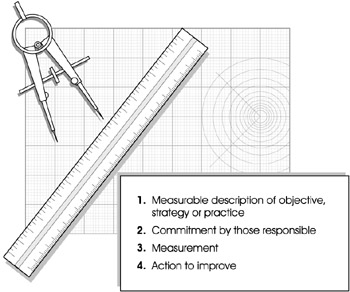
Measurement has a logical sequence, summarized in Chart 11.2.
Measurable description Vision and values are unlikely to...