Digital Watermarking

Learn about this key ingredient to copyright protection.
 TABLE OF CONTENTS
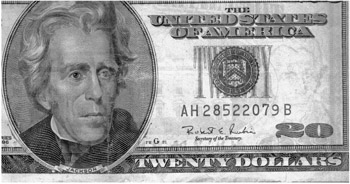
 Hold an American $20 bill up to the light. If you are looking at the side with the portrait of president Andrew Jackson, you will see that the portrait is echoed in a watermark on the right. This watermark is embedded directly into the paper during the papermaking process, and is therefore very difficult to forge. It also thwarts a common method of counterfeiting in which the counterfeiter washes the ink out of $20 bills and prints $100 bills on the same paper.
The watermark on the $20 bill (Figure 1.1), just like most paper watermarks today, has two properties that relate to the subject of the present book. First, the watermark is hidden from view during normal use, only becoming visible as a result of a special viewing process (in this case, holding the bill up to the light). Second, the watermark carries information about the object in which it is hidden (in this case, the watermark indicates the authenticity of the bill).
In addition to paper, watermarking can be applied to other physical objects and to electronic signals. Fabrics, garment labels, and product packaging are examples of physical objects that can be watermarked using special invisible dyes and inks [224, 228]. Electronic representations of music, photographs, and video are common types of signals that can be watermarked.
The techniques presented in this book focus on the watermarking of electronic signals. We adopt the following terminology to describe these signals. We refer...