Digital Watermarking

Learn about this key ingredient to copyright protection.
 TABLE OF CONTENTS
 The watermarking systems presented in the preceding chapter all fit into the basic model shown in Figure 5.1. In each embedder, a message, m, is first encoded as a message mark, w m. This is then modified by simple scaling to obtain an added mark, w a, which is added to the cover Work. The detectors are blind, in that they are not given any information about the original, unwatermarked Work. The embedders in these systems can be thought of as blind in the same sense. They ignore the available information about the cover Work during both the coding of the message ( blind coding) and the modification of the message mark in preparation for embedding ( blind embedding).
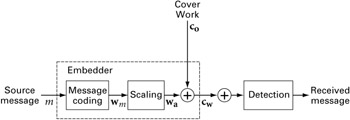
In contrast, in Chapter 3, we discussed two types of systems that cannot be fit into Figure 5.1. The first type was systems that use informed detection (see Section 3.3.1 of Chapter 3), in which the detector is provided with information about the original, unwatermarked cover Work. It can then subtract this information from the received Work, eliminating any interference between the cover Work and the watermark. With an informed detector, then, the detectability of the watermark is affected only by the distortions to which the watermarked Work is subjected after embedding; it is not affected by the cover Work itself.
The second type of non-blind system discussed in Chapter 3 was a system that uses informed...