Dynamics of Profit-Focused Accounting: Attaining Sustained Value and Bottom-Line Improvement

In the discussion on balanced scorecards, considerable emphasis was given to mapping and measuring strategy. Defining strategy will provide a different slant to strategic components including how and where an organization s value proposition should be executed. This discussion sets the tone for describing and explaining the common measurements and how to compute them.
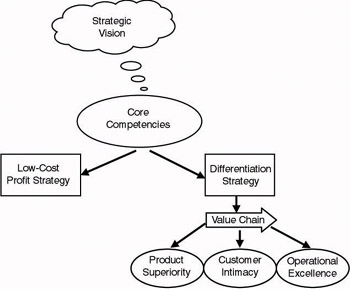
In Figure 13.4, we see how different strategies drive the need for different metrics. The illustration begins by showing a flow from core competency to three different strategic themes. Core competency requires consistent, time-tested measurements that are prerequisites needed to execute any strategy. These measurements will be identified and explained. Low-cost profit strategies include those metrics that concentrate on maximizing short and intermediate profit levels and maintaining a strategy focused on being the low-cost producer in the market. Differentiation strategies seek to be unique in their market. These strategies focus on attributes that include customer relationships, superior products and service, or operational excellence. The three niche strategies all have unique performance measurement requirements and are defined with an explanation of how to calculate them. Metrics for each of the strategies are described, including how to calculate them, why they are important, and how to interpret the data.