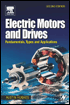
Electric Motors and Drives: Fundamentals, Types and Applications, Third Edition
TRANSIENT BEHAVIOUR CURRENT SURGES

It has already been pointed out that the steady-state armature current depends on the small difference between the back e.m.f. E and the applied voltage V. In a converter-fed drive it is vital that the current is kept within safe bounds, otherwise the thyristors or transistors (which have very limited overcurrent capacity) will be destroyed, and it follows from equation (3.8) that in order to prevent the current from exceeding its rated value we cannot afford to let V and E differ by more than IR, where I is the rated current.

It would be unacceptable, for example, to attempt to bring all but the smallest of d.c. motors up to speed simply by switching on rated voltage. In the example studied earlier, rated voltage is 500 V, and the armature resistance is 1 ?. At standstill, the back e.m.f. is zero, and hence the initial current would be 500 /1 1/4 500 A, or 25 times rated current! This would destroy the thyristors in the supply converter (and/or blow the fuses). Clearly the initial voltage we must apply is much less than 500 V; and if we want to limit the current to rated value (20 A in the example) the voltage needed will be 20 1, i.e. only 20 V. As the speed picks up, the back e.m.f. rises, and to maintain the full current V must also be ramped up so that the...

UNLIMITED FREE
ACCESS
TO THE WORLD'S BEST IDEAS

SUBMIT
Already a GlobalSpec user? Log in.

This is embarrasing...

An error occurred while processing the form. Please try again in a few minutes.

Customize Your GlobalSpec Experience

Category: DC Motor Starters
Finish!
Privacy Policy

This is embarrasing...

An error occurred while processing the form. Please try again in a few minutes.