Electric Motors and Drives: Fundamentals, Types and Applications, Third Edition
TOY MOTORS

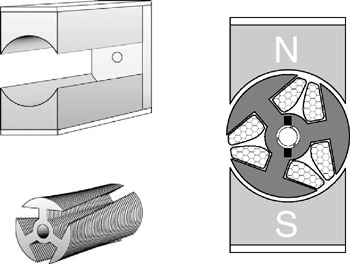
The motors used in model cars, trains etc. are rather different in construction from those discussed so far, primarily because they are designed to be cheap to make. They also run at high speeds, so it is not important for the torque to be smooth. A typical arrangement used for rotor diameters from 1 cm to perhaps 3 cm is shown in Figure 3.18.


Figure 3.18: Miniature d.c. motor for use in model toys

The rotor, made from laminations with a small number (typically three or five) of multi-turn coils in very large slots , is simple to manufacture, and because the commutator has few segments, it too is cheap to make. The field system (stator) consists of radially magnetised ceramic magnets with a steel backplate to complete the magnetic circuit.

The rotor clearly has very pronounced saliency, with three very large projections which are in marked contrast to the rotors we looked at earlier where the surface was basically cylindrical. It is easy to imagine that even when there is no current in the rotor coils, there is a strong tendency for the stator magnets to pull one or other of the rotor saliencies into alignment with a stator pole, so that the rotor would tend to lock in any one of six positions. This cyclic detent torque is due to the variation of reluctance with rotor position, an effect which is exploited in a.c. reluctance motors (see Chapter 9), but is unwanted here. To combat the problem...

UNLIMITED FREE
ACCESS
TO THE WORLD'S BEST IDEAS

SUBMIT
Already a GlobalSpec user? Log in.

This is embarrasing...

An error occurred while processing the form. Please try again in a few minutes.

Customize Your GlobalSpec Experience

Category: Stepper Motors (rotary)
Finish!
Privacy Policy

This is embarrasing...

An error occurred while processing the form. Please try again in a few minutes.