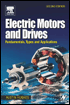
Electric Motors and Drives: Fundamentals, Types and Applications, Third Edition
In this chapter the common feature which links the motors is that they are all a.c. motors in which the electrical power that is converted to mechanical power is fed into the stator, so, as with the induction motor, there are no sliding contacts in the main power circuits. All except the switched reluctance motor also have stators that are identical (or very similar) to the induction motor.
We begin by looking at motors that are intended to be operated directly off the mains supply, usually at either 50 or 60 Hz. These motors are known as synchronous or reluctance motors, and they provide a precise, specific and constant speed for a wide range of loads, and are therefore used in preference to induction motors when constant speed operation is essential. Such machines are available over a very wide range from tiny single-phase versions in domestic timers to multi-megawatt machines in large industrial applications such as gas compressors. Their principal disadvantage is that if the load torque becomes too high, the motor will suddenly lose synchronism and stall.
To overcome the fixed-speed limitation that results from the constant frequency of the mains, controlled-speed synchronous motor drives simply use a variable-frequency inverter to provide for variation of the synchronous speed. These open-loop drives are dealt with next.
We then look at what are perhaps best referred to as self-synchronous drives, which potentially over competition for d.c. and induction motor drives. In these drives the motor is basically a synchronous motor...