Engineering Geology, Second Edition
Illustrating key points with diagrams and photographs, this book introduces the techniques that engineers will need to learn about and understand the geological conditions in which they intend to build.
 TABLE OF CONTENTS
 According to their origin, rocks are divided into three groups, namely, the igneous, metamorphic and sedimentary rocks.
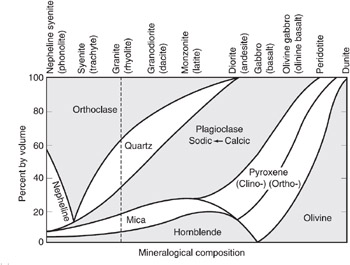
Igneous rocks are formed when hot molten rock material called magma solidifies. Magmas are developed when melting occurs either within or beneath the Earth s crust, that is, in the upper mantle. They comprise hot solutions of several liquid phases, the most conspicuous of which is a complex silicate phase. Thus, igneous rocks are composed principally of silicate minerals. Furthermore, of the silicate minerals, six families the olivines [(Mg,Fe) 2SiO 4], the pyroxenes [e.g. augite, (Ca, Mg, Fe, Al) 2(Al,Si) 2O 6], the amphiboles [e.g. hornblende, (Ca,Na,Mg,Fe,Al) 7-8(Al,Si) 8O 22(OH) 2], the micas [e.g. muscovite, KAl 2(AlSi 2) 10(O,F) 2; and biotite, K(Mg,Fe) 2(AlSi 3)O 10(OH,F) 2], the feldspars (e.g. orthoclase, KAlSi 3O 8; albite, NaAlSi 3O 8; and anorthite, CaAl 2Si 2O 8) and the silica minerals (e.g. quartz, SiO 2) are quantitatively by far the most important constituents. Figure 1.1 shows the approximate distribution of these minerals in the commonest igneous rocks.
Igneous rocks may be divided into intrusive and extrusive types, according to their mode of occurrence.